
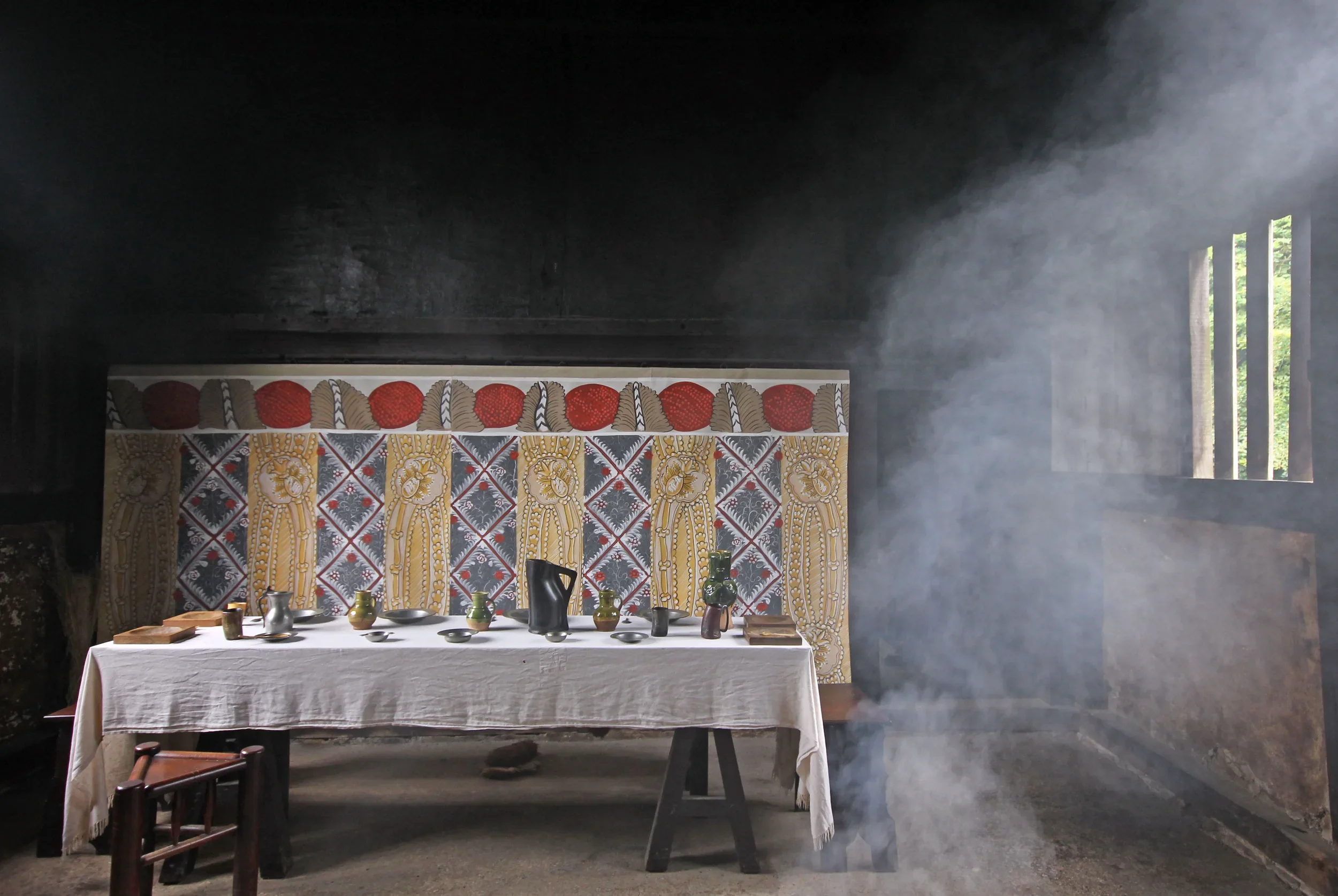
Bayleaf painted cloth
Client
Weald & Downland Living Museum
Location
Date
Bayleaf Farmhouse, Singleton, Chichester
2014
Bayleaf is a late medieval open-hall house dating from the early fifteenth and sixteenth centuries. It was moved to the Weald & Downland Living Museum near Chichester in 1968 and has been interpreted to represent a domestic interior of around 1540: one of the most visited and best-loved buildings in the museum's extraordinary collection.
When the museum's original cloth (a woven wool and silk damask hung behind the high table since the 1980s) had faded and deteriorated beyond repair, they commissioned a replacement in the painted cloth tradition: a form of decoration ubiquitous in sixteenth-century interiors but of which pitifully few examples survive today.
The design I was asked to re-interpret was based on a set of wall paintings surviving at Althrey Hall in Flintshire, North Wales, dated to around 1550: close enough to Bayleaf's interpreted period and sufficiently well preserved to offer a reliable source. It is a bold, graphic design of alternating stripes: one carrying a pomegranate motif in yellow ochre, the other a rosette set within a diamond trellis. Running across the top is a border of open pomegranates interspersed with acanthus leaves. The pomegranate is a motif laden with Elizabethan resonance: regal, symbolic of fertility and regeneration, its crown-like flower a declaration of status appropriate to the head of the table.
I stretched two pieces of medium-weight unbleached canvas onto separate frames, primed with rabbit skin glue for a taut, receptive surface, and painted in traditional pigments: red and yellow ochre, umber, lamp black and whiting. These were all cheap and readily available materials, as they would have been to the original craftsmen. The jewel-like dots of colour on the pomegranate seeds (the most expensive element of any such scheme) catch the light in the hall in a way that would have impressed a sixteenth-century visitor and still does. Installed, it dwarfs itself against the imposing height of the hall and draws the eye precisely to the important end of the room.
If you are working on a project of this kind, I would be glad to hear from you. at the earliest stage.
“Reinterpreting this 1550 design for Bayleaf was an exercise in symbolic resonance. The bold pomegranate motifs and jewel-like dots of color catch the light in the hall, declaring status and fertility exactly as they would have impressed a visitor five centuries ago.”