
The Bell, Ticehurst
The Bell
Client
Location
Ticehurst, East Sussex
Date
2020
The Bell in Ticehurst has been lodging travellers since 1645. It is the kind of building that has spent four centuries accumulating character: wonky floors, exposed Tudor beams, ceilings propped up by teetering stacks of books, silver birch trees growing through the bedrooms. When Philippa King and owner Richard Upton commissioned me to design the wallpaper for the Big Room in 2020, I knew the brief was not for something refined and restrained. It was for something that could hold its own in a room like that.
The Design
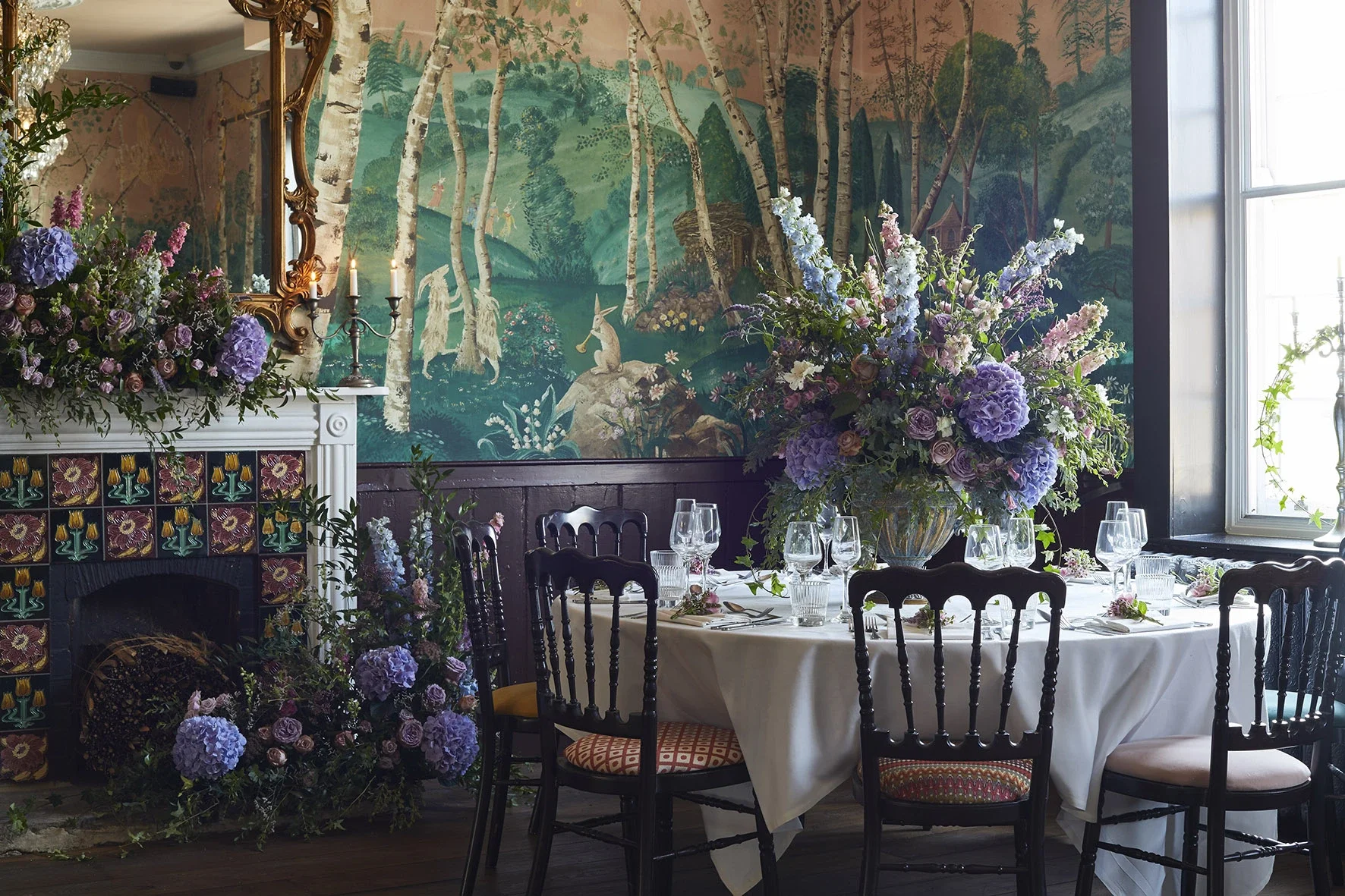
I began with the name. Ticehurst comes from the Saxon ticcenes hyrst: a wooded hill where young goats are kept. The goats are in the landscape. So are the hills and the woods.
But the deeper source for this design is the nearby Ticehurst House Hospital, an eighteenth-century institution with a remarkably enlightened philosophy for its time: that nature had the power to "amuse and cheer the mind." The hospital's original grounds included a pagoda, a gothic summerhouse, and a moss-house, all of which appear in the mural. The moss-house is a quiet nod to The Love Nest, The Bell's famous honeymoon suite, for those who know where to look.
The design is full of decisions made for specific reasons. Lily of the Valley runs through the scene as a gesture to the room's life as a wedding venue: a symbol of purity and happiness woven into the landscape rather than applied as ornament. The row of blackbirds is a reference to the Sussex martlet, the mythical heraldic bird of the county. Bells hang between the trees. Buffalo appear, a nod to the pub's trophy heads. Chandeliers swing from arched birch branches: a perfect photographic backdrop for couples, and a connection between the painted world and the chandeliers overhead in the real room.
The Wealden Times described it as "a tailor-made scene that pays homage to the local area, offering the whimsy and eclecticism that lies at the heart of The Bell." That is what I was aiming for.
The Process
I painted the original composition in my Hastings studio, working with the looser folk-art hand that suits a building of this age and temperament. The imperfections of the brushwork were preserved through the digitisation process, so that the final printed rolls carry the warmth and irregularity of the hand-painted original. The mural runs as six unique panels (A to F), printed on 70cm pre-trimmed rolls for a seamless edge-to-edge installation.
This is the paint to pixel to print process at its most site-specific: the design belongs to this room, and to this building, and it could not have been made for anywhere else.
The Bell as living commission
There is something particular about teaching in a room you have papered. My Painted Treasure Box workshops at The Bell, run in partnership with Curious House, place participants inside a full-scale demonstration of the scenic style, surrounded by the very surface qualities I am helping them develop. Sainsbury's Magazine described the experience as being "beneath chandeliers and enveloped by the hand-painted woodland fresco." That is a good description of what it feels like to work in that room.
“I designed a tailor-made scene that pays homage to the local High Weald, where goats graze on wooded hills. Every detail ~ from the lily of the valley to the swinging chandeliers ~ was chosen to hold its own in a room propped up by Tudor beams.”