
Shakespeare's Birthplace Museum
Shakespeare's Birthplace Trust
Client
Location
Shakespeare's Birthplace Museum, Henley Street, Stratford-upon-Avon
2000
Date
This was a pivotal and career defining project for me that spanned four years as commission funding was released in stages for an ambitious re-display project at this much loved historic site.
Intensive and thorough research was carried out by experts in the field of Tudor interior decoration: David Cutmore and Victor Chinnery. Former Museum Curator Ann Donnelly oversaw the project and a team of artists, myself included, carried out the painting under David’s guidance. This was the project that lured me into the world of Tudor wall painting. This is where I learned to read Elizabethan wall paintings; mix pigments; prepare rabbit skin glue; stretch and tack linen canvas and wield a brush in the manner of the painter-stainers of the Sixteenth Century.
The Brief
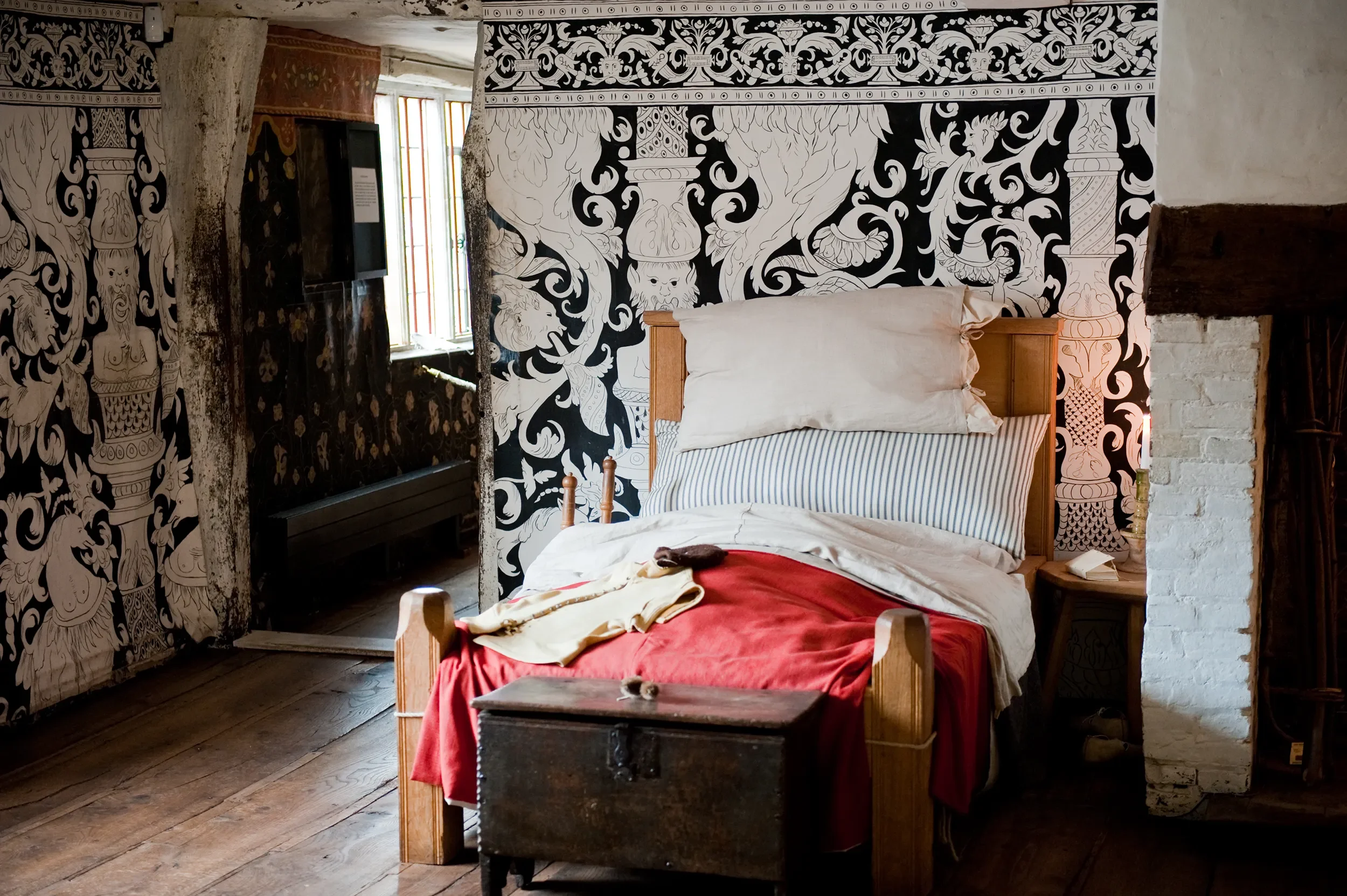
When the Shakespeare Birthplace Trust invited craftsman David Cutmore to join their re-display project he and his team of decorative artists got to work producing a set of painted cloths. They replicated wall paintings that Shakespeare would have seen in nearby towns like Oxford.
Using traditional materials (earth pigments & size) and techniques (stencils & templates) the team stretched linen on huge frames and painted floor-to-ceiling cloths for four rooms, including the Birthroom.
The Design
The museum’s interiors had whitewashed walls and exposed oak beams like many timber-framed houses across the country. It is now known that rooms were far more colourful with elaborately painted walls and often ceilings, floor cloths, furniture etc.
The museum’s transformation challenged visitors’ expectations but ultimately showed how the house might have looked when Shakespeare lived in it.
The finished cloths were installed by David and me in 2000. On site we fixed wooden battens around the walls and then tacked the cloths to these using copper tacks, stretching the cloth taut as we went and trimmed the surplus away with scissors, rather like fitting a tailored suit.
My research into the painter-stainer tradition remains a live, evolving practice rather than a static point of reference. I am particularly drawn to commissions where the brief demands historical integrity ~ museums, significant heritage properties, and projects where accuracy is as vital as the artistry itself. If you are working on a project of this kind, I welcome a conversation where you feel my historically informed work may resonate.
“This was the project that lured me into the world of Tudor wall painting. Wielding a brush in the manner of the 16th-century painter-stainers taught me how to read the soul of these historic interiors, transforming white walls into a vibrant, storied home for the Bard.”