
The Royal Court Collection: GP&J Baker for Historic Royal Palaces
GP&J Baker for Historic Royal Palaces
Client
Location
Launched at Paris Déco Off
Date
2025
The Tudor tapestries at Hampton Court Palace are among the most significant decorative objects in the Royal Collection. Woven in the sixteenth century, they depict verdant landscapes populated with beasts, birds, and courtly scenes: an entire imagined world hung across the walls of the Great Hall. They were the prestige decoration of their age, the thing that announced, to anyone entering that room, the scale of royal ambition.
I have spent my career working in the tradition those tapestries belong to. Not the woven tradition, but the painted one: the painted cloths and water-works that served as the Tudor alternative for households that could not afford the woven article, and that covered the walls of houses from manor to farmhouse across Elizabethan England. It is the tradition I researched at Shakespeare's Birthplace in 2000, painting floor-to-ceiling cloths using rabbit-skin glue and earth pigments in the manner of the painter-stainers of the sixteenth century. It is the same tradition that informed the landscape I painted for the Queen's summerhouse at Buckingham Palace in 2013.
When GP&J Baker approached me to develop the Royal Court Collection in collaboration with Historic Royal Palaces, the connection between those early commissions and this one felt immediate.
The Collection
The starting point was Hampton Court: the park, the architecture, the particular quality of a royal landscape that has been tended and observed for five centuries. The Great Hall's tapestries gave me the compositional logic. The palace grounds gave me the content.
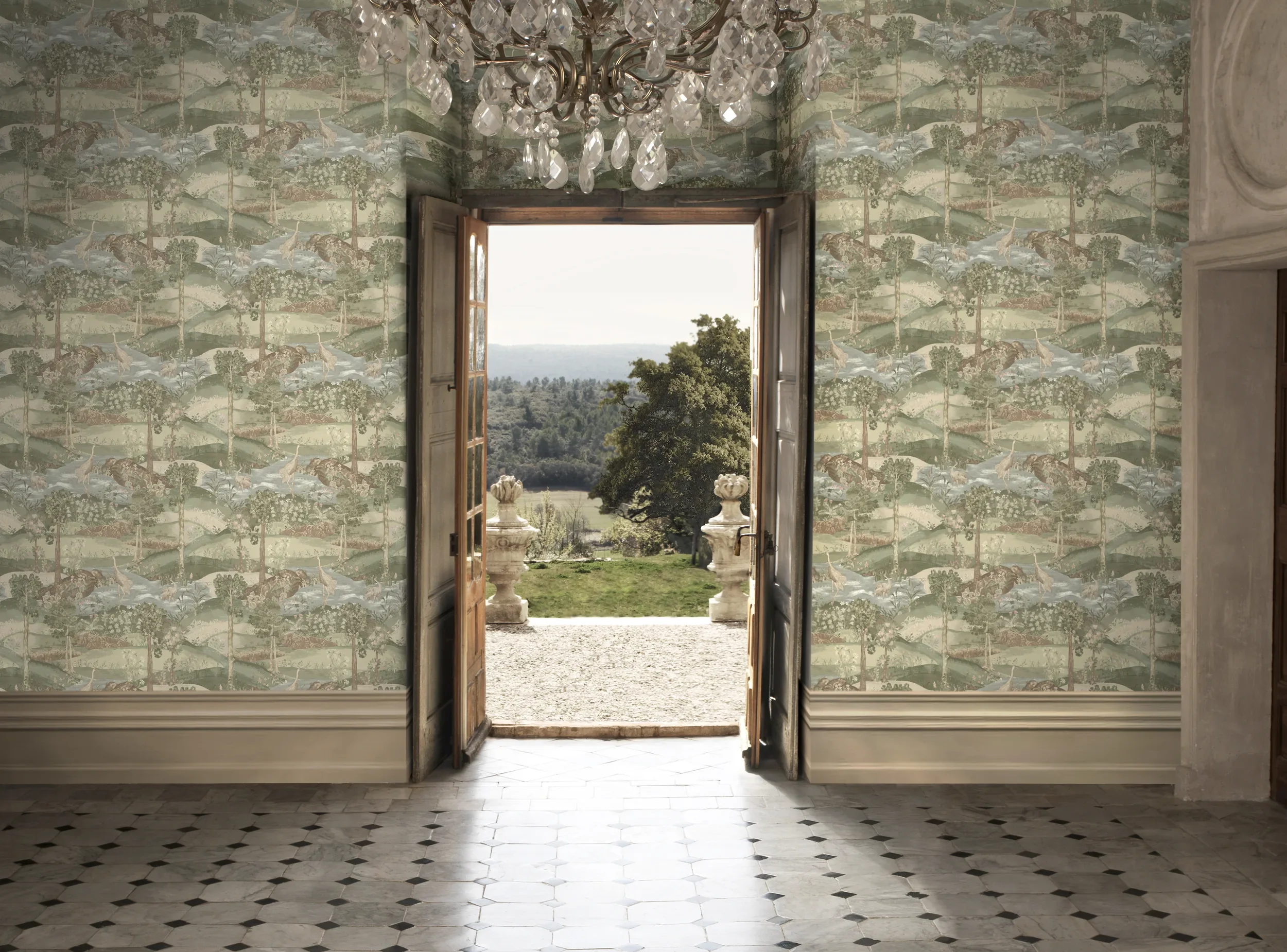
The Royal Park Panel is a large-scale scenic wallpaper: a magical, fantastical parkland populated with stylised flora and fauna, the River Thames threading through the middle distance, and the green-and-white striped poles of Chapel Court carrying the Royal Tudor Beasts. It is the kind of design that operates at two levels simultaneously: as atmosphere from across the room, and as a world of specific detail the closer you get. The beasts are identifiable. The poles are accurate. The river is the Thames.
The Palace Tapestry is the companion design: a smaller-scale all-over pattern that draws from the same parkland scene, bringing the same vocabulary of flora and fauna into a format that works across larger surfaces and as a coordinate to the panel.
The collection launched at Paris Déco Off in January 2025.
Drawing History into the Present
What interests me about the Royal Court Collection is the distance it covers. The Tudor tapestries at Hampton Court were made by Flemish weavers working from cartoons, translated through a production process of considerable complexity into objects of extraordinary luxury. The painted cloths I researched at Shakespeare's Birthplace were made by itinerant craftsmen working directly onto stiffened linen with earth pigments and size. Both were doing the same thing: putting a landscape on a wall in a way that transformed the room.
The Royal Park Panel was hand-painted in my Hastings studio. I scanned and digitally translated the artwork myself, retaining full control of the process up to the point of handing over the final production-ready file. GP&J Baker then developed the colourways in-house. Both designs were conceived from the outset to sit alongside the wider collection, which was hand-painted by their in-house design team. I think it's a good example of how bringing in an independent artist like myself brings a new and unexpected vocabulary to an already strong brand language.
The Royal Court Collection is available via GP&J Baker. If you are working on a project where the scale and provenance of the source material matters as much as the design itself, I would welcome a conversation.
“It is the kind of design that operates at two levels simultaneously: as atmosphere from across the room, and as a world of specific detail the closer you get.”