
Stiffkey Old Hall, Norfolk
Private, Stiffkey Old Hall
Client
Location
Stiffkey Old Hall, Norfolk
Collaboration
With the late David Cutmore
Date
2008
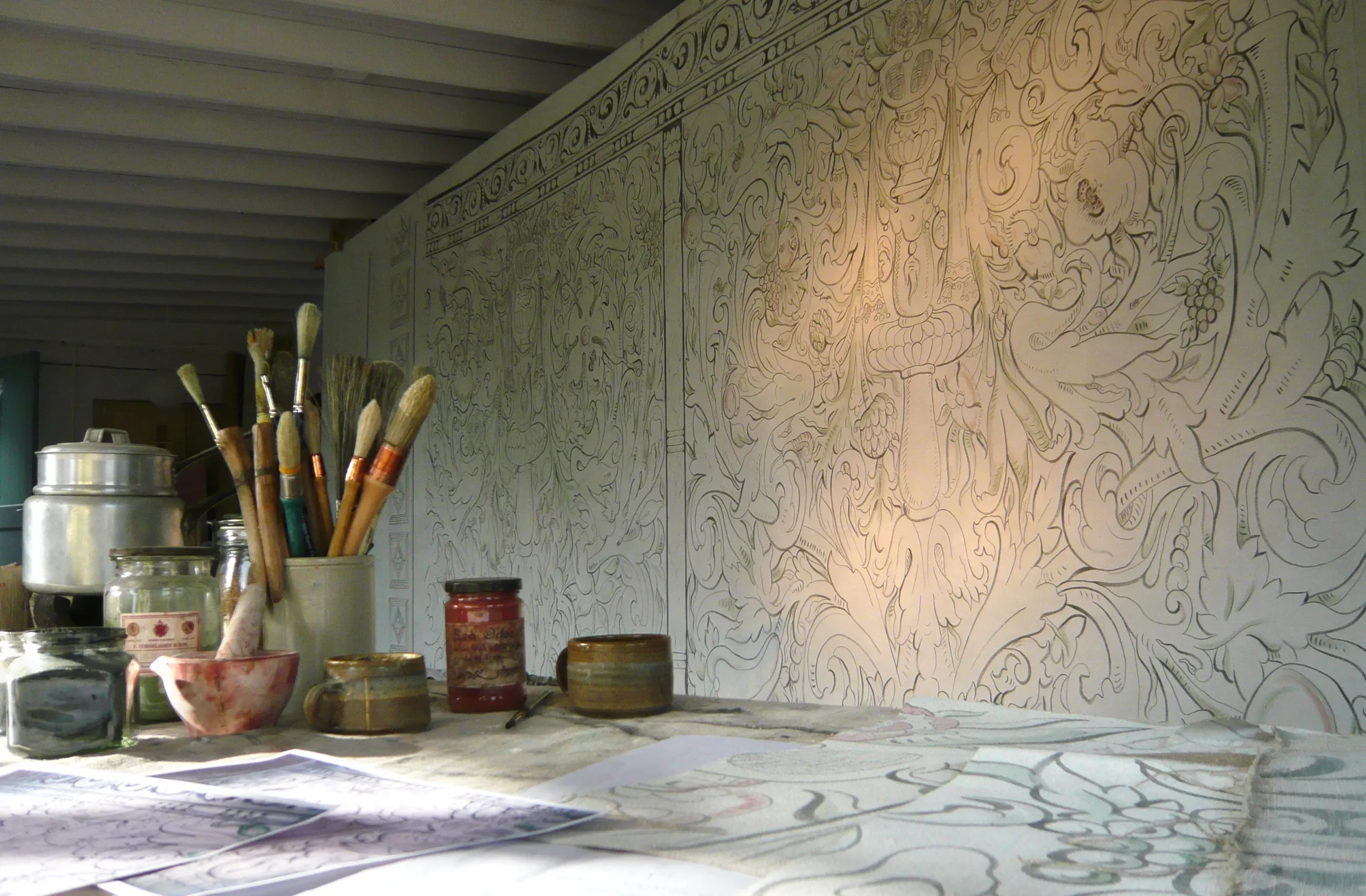
A set of painted cloths fitted wall-to-wall in a guest bedroom of this grand Elizabethan country house.
This was a wonderful collaboration with my studio partner the late David Cutmore. The project coincided with my move into my current studio in Hastings in 2008. With a higher ceiling, we were finally able to accommodate the enormous stretcher frames that work of this scale demands.
The Brief
The building of Stiffkey Old Hall was begun in 1576 by Sir Nicholas Bacon, lawyer and Lord Keeper of Elizabeth I's Great Seal. As part of extensive restoration work, the current owners discovered the remains of eighteenth-century stencilling in a guest bedroom. Required by English Heritage to preserve this historically important decoration but unable to display it openly, they devised an elegant solution: to fabric-wall the room entirely, creating a breathable air gap around the perimeter. We also incorporated a secret panel that could be removed to reveal the finest surviving section of the original stencilling.
The Design
David and I proposed a black and white "antique work" design, a genre at the height of fashion in late sixteenth-century Elizabethan England. The source is a wall painting that survives to this day in a sixteenth-century townhouse in Sandwich, Kent.
It is a fine example of the typical format of these floor-to-ceiling schemes: a border at the top, a dado design at the bottom, and the main fill in between. The scrolling multivine, laden with foliage, fruit, vegetables, snails, and butterflies, is divided by pilasters. Look more closely and the dense vine reveals itself to form a heart shape, centred on a giant ornamental column: one of those concealed rewards that make Elizabethan wall painting so endlessly repaying of careful attention.
In the original source there are two versions of the scrolling heart motif, one favouring fruit and one vegetables. For the guest bedroom we alternated these around the room, and added imitation dado panelling at the base to address the height of the walls. Above the doors we created cartouches with Latin sayings chosen by the clients.
The Process
At the studio, we built a substantial wooden stretcher frame on industrial pulleys, allowing us to prime the linen horizontally on the floor before winching it into a vertical position for painting. Following established tradition, the canvas was primed with rabbit skin glue for a drum-tight surface, followed by a base coat of white distemper. For the detail work we used glue tempera made with lamp black pigment. If you have seen our work at Shakespeare’s Birthplace, you will recognise this specific historical method.
The particular challenge here, however, was in the translation of the design. While I have always loved this bold, voluptuous multivine, the heavy black lines of the original wall painting threatened to overwhelm a four-walled bedroom. By softening the lamp black to a subtle charcoal, we gave the design a contemporary elegance and room to breathe without losing the authority of the source.
Like tailoring a suit, we mapped each section of the room and painted the design in sections to fit the walls perfectly, even using a fixed horizontal laser line to survey the undulations where the ceiling met the frieze. Each panel was painted using an OHP to ensure accuracy while maintaining the spirit and nuance of freehand work. Once complete, the panels were cut from the frame, rolled up and sent to Stiffkey to be installed by professional fabric-wallers, who used matching braid to seamlessly cover the joins.
I particularly welcome commissions where the brief is historically informed: museum spaces, significant historic houses, and buildings where the context demands accuracy as much as artistry.
“I’ve always loved this bold, voluptuous multivine design. However, the dark black lines of the original wall painting could overwhelm across four walls of a bedroom. Softening the black to a subtle charcoal allowed the design more elegance and room to breath.”