
Brownsover Hall Hotel: a Magical Map of Brownsover
The Distinct Group via YesFoundry
Client
Location
Rugby, Warwickshire
Date
December 2025
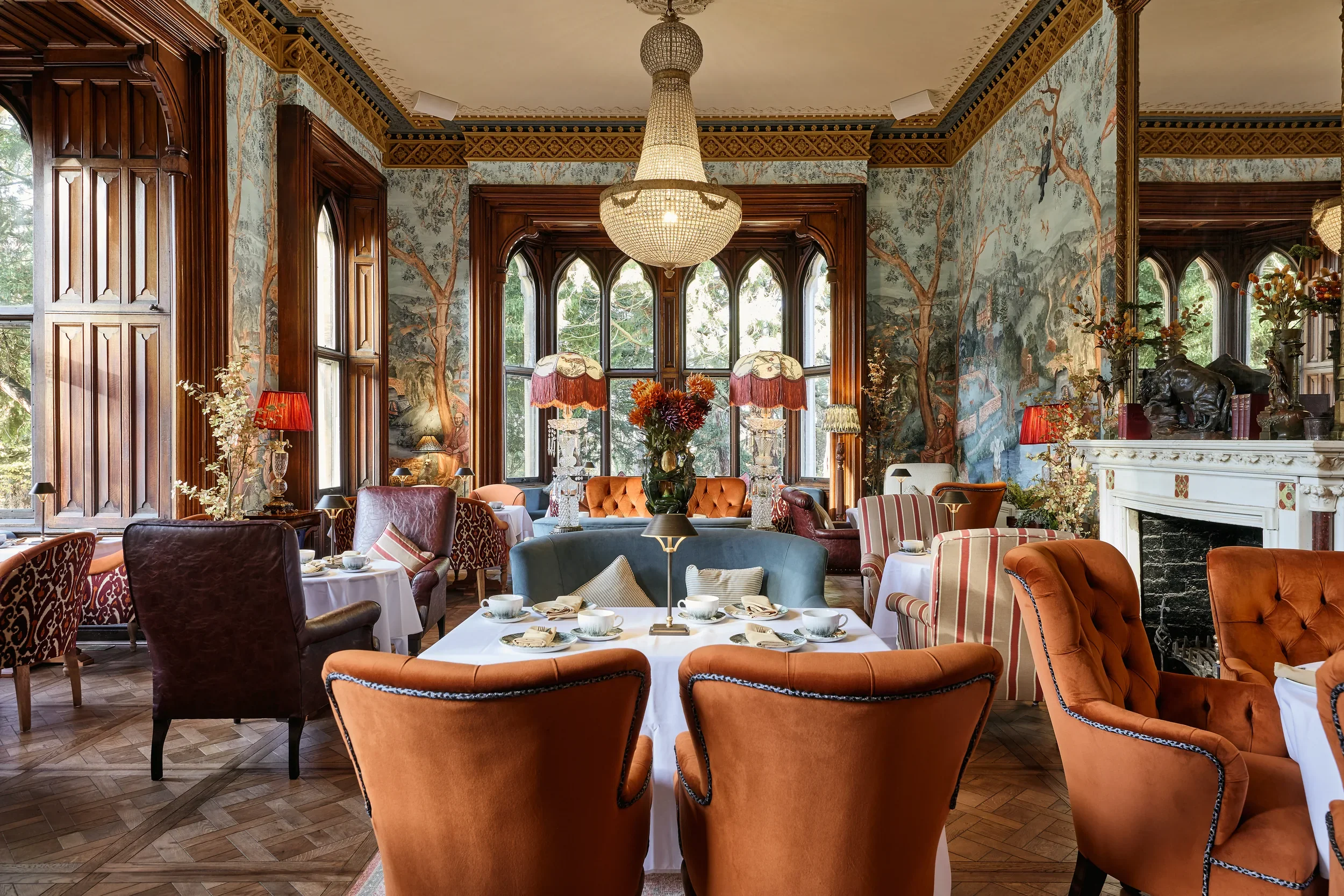
Brownsover Hall is a Grade II listed Victorian Gothic mansion designed by Sir George Gilbert Scott, the architect behind the Albert Memorial and St Pancras station. It is not the kind of building that asks for timid decoration. When YesFoundry approached me on behalf of the Distinct Group in 2025, the brief for Boughton's Tearoom was, in their words, to celebrate the Hall's rich and quirky history, but to make it mischievous. That brief made my heart sing.
A tearoom is already a pause in the day. A tearoom in a Victorian Gothic mansion, in a room with that kind of ceiling height and that kind of light, needed a wallpaper that could hold the room, reward a slow look, and earn its place among the architecture. The design had to feel like it had always been there, and also like it could only have been made now, for this building, by someone who had spent time with its history. I was furnished with images of the architecture, the gargoyles, the canal, the local landmarks, and the particular cast of characters Brownsover has accumulated over the centuries. From those, I began building a world.
At first glance, the wallpaper reads as a lush Warwickshire landscape: sweeping hills in rich teal and burnt orange, the Oxford Canal winding through the scene, a bucolic setting for the Hall at its centre. The palette was developed to sit within the room's existing tones, and the composition was scaled precisely to the proportions of the Victorian tearoom, so that the landscape feels continuous rather than applied. But step closer, and the mischief begins.
Brownsover already had the best cast of characters: its own gargoyles. I gave them permission to climb off the building and roam the landscape. Snakes, mice, a griffin, a winged gremlin, and cat-like watchers peer from branches, walls, and undergrowth. They are Brownsover's own creatures, liberated. Then come the historical threads. George Gilbert Scott himself appears seated beneath a tree, compasses in hand, in conversation with the creatures around him. Architectural nods to his brilliance appear in the middle distance: Battersea Power Station, the Albert Memorial. A red telephone box sits tucked behind a brick wall: a quiet reference to the Soane and Scott lineage that lies behind that most British of icons.
High in the treetops, Sir Frank Whittle looks out from beneath his RAF cap, the turbojet engine beside him. Whittle carried out design work on the jet engine at Brownsover Hall from 1940. It felt important to find him somewhere appropriately elevated. And floating in the river: a bottle. It refers to the legend of Sir Theodosius Boughton and the tale of the "one-handed apparition" said to have been trapped in a blessed bottle and thrown into a nearby lake, until curious fishermen opened it again. Every good English house has a ghost story, and this one is particularly strange. I could not resist. The wallpaper is not a literal map of Warwickshire; it is a mythic version of place, where history, legend, and imagination are allowed to sit in the same scene.
The design began as a layered Photoshop collage: a planning tool to establish where the narrative elements should sit in relation to one another. Once that structure was settled, the process became satisfyingly analogue. I printed the composite, traced it in pencil, transferred the drawing to acetate, and projected it in the studio using an overhead projector. This guides the overall structure without being prescriptive, and leaves room to free-style the actual painting. I work across wide paper (150cm), building up the surface with spontaneous layers: rolled brushwork, textured strokes, and torn paper edges, followed by gentle distressing to reveal pentimenti, the traces of earlier layers visible beneath. Finally, a dead-flat varnish brings the whole surface back to life.
The completed artwork was then scanned, refined digitally into a seamless repeat, and printed on non-woven, parchment-coated matte wallpaper specifically chosen to preserve the hand-painted feel at scale. The trace of the hand travels through every stage of the process. That is what makes it feel like a mural rather than a wallcovering.
Boughton's Tearoom at Brownsover is among the most recent examples of what I find most satisfying: a genuinely site-specific commission, where the research shapes the design from the beginning, and the finished wallpaper belongs to that room and no other.
If you are working on a hotel, a heritage building, or a hospitality space that deserves something made entirely for it, I would welcome an early conversation.
“Your work is absolutely stunning!
The truest form of a storytelling wallpaper I’ve ever seen, bravo and I love the connection between you and the history at Brownsover Hall Hotel. What a perfect collaboration.”
“I was told to celebrate the Hall’s history, but make it mischievous. I gave the building’s own gargoyles permission to climb off the Victorian Gothic architecture and roam a mythic Warwickshire landscape where history, legend, and imagination sit in the same scene.”